project.backToProjects
A unified hub for exploring and analysing global nuclear-weapon-free zones
Frontend
Backend
UX/UI

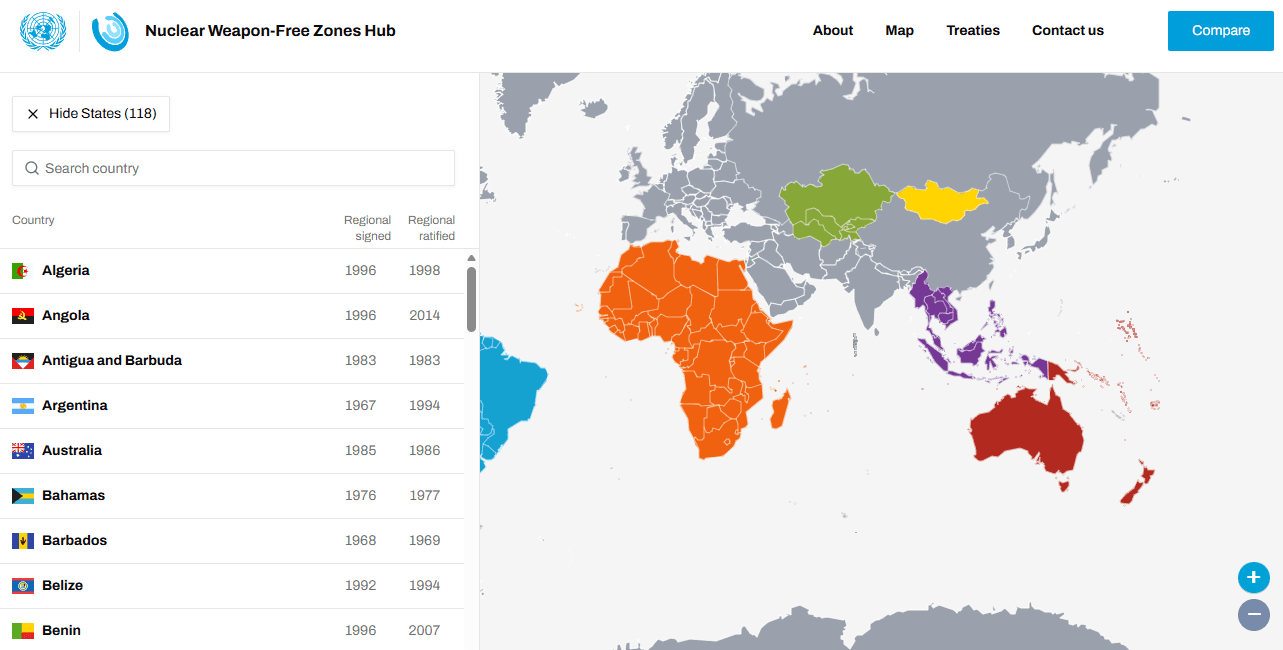
NWFZ-hub brings together maps, treaties and key provisions of five nuclear-weapon-free zones. It enables rapid comparison, supports negotiations and clarifies complex international frameworks in nuclear disarmament.
Country
Switzerland
Area
Policy
Hours worked
700 formatters.hours
Collaboration
2025
01
About the project
Nuclear Weapon-Free Zones hub is a specialised platform that clarifies international nuclear-weapon-free zone frameworks and enables rapid comparison of their key provisions. The project was created in response to the need to consolidate complex data, map layers and treaty documents into a single modern and easy-to-use tool.It supports diplomats, researchers and expert institutions working on nuclear disarmament and international security. Thanks to its clear structure and interactive elements, it helps users better understand the differences between individual regions and provides a reliable basis for further analysis and decision-making.
02
DevX team involvement
We joined the project before development even began. It was necessary to design an approach to presenting large volumes of data effectively, define data models and create an environment that would be both professional and accessible.We started by designing the entire user environment: from initial wireframes through UX logic to the final UI, which respects the character of a UN project while supporting quick orientation within the content.We built the frontend on Next.js, the backend on Node.js and content management on Strapi CMS, which we customised to meet the project's specific needs. We developed interactive elements, map visualisations and the logic for comparing individual zones. Throughout the process we continuously refined details with the client, tested functionality and verified data accuracy.The collaboration also included assistance with content population and data structure preparation, which is a natural part of our long-term project stewardship and an area that has helped us maintain a strong and lasting relationship with the UN. We manage the complete operation of the platform, its security, updates and technical support to keep the system stable, fast and ready for further development.
03
Modern and secure technology
For this project we chose a modern and flexible stack that enables rapid development, easy content management and long-term sustainability.The frontend runs on Next.js, which delivers high performance, fast load times and the ability to generate both static and dynamic parts of the platform. The backend is built on Strapi CMS, which we extended with custom data models and logic to meet the project's specific requirements.This combination allowed us to work efficiently with complex data, build interactive visualisations and maintain a high degree of flexibility for future expansion, such as adding new regions, documents or analytical tools.
04
Functionality and results
The result is a platform that is clear, fast and professionally precise. It fully meets United Nations standards and strict security requirements. Users can easily compare individual nuclear-weapon-free zones, browse maps, read key treaty provisions and quickly navigate complex international frameworks.The project today stands as an example of how even highly complex expert content can be transformed into an intuitive digital tool that supports informed decision-making and international cooperation.